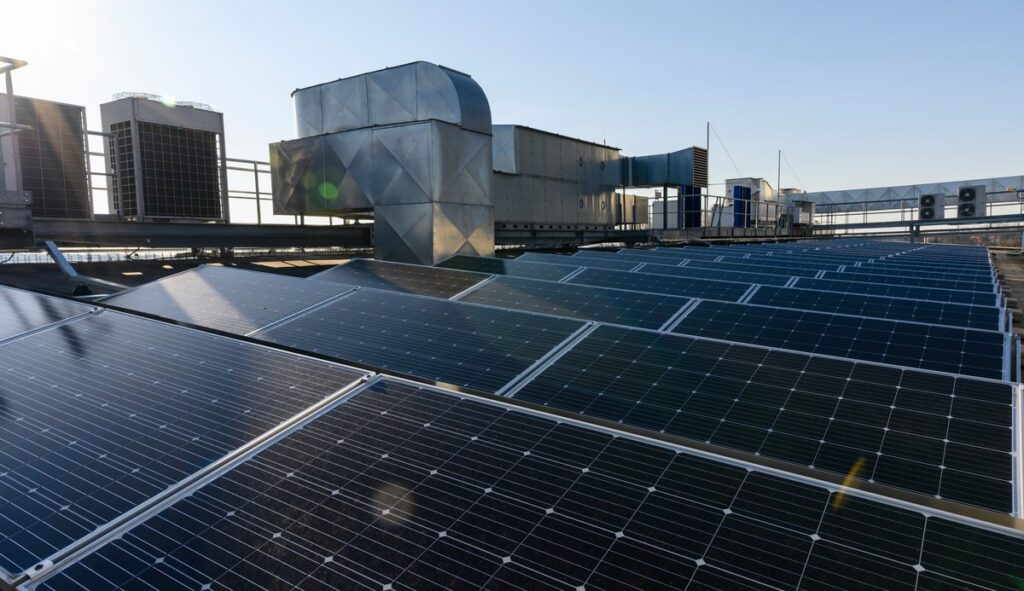
The UK’s journey towards a lower-carbon future is often associated with major infrastructure projects, from offshore wind farms to utility-scale solar developments. However, one of the country’s most significant renewable energy opportunities may already be in place. It sits above our heads every day on the roofs of warehouses, factories, schools, hospitals and countless other non-domestic buildings.
Across the UK, commercial, industrial and public sector buildings offer a vast amount of roof space capable of supporting solar PV installations. For organisations facing rising energy costs and increasing pressure to reduce carbon emissions, these rooftops represent an opportunity to generate clean electricity at the point of use while making better use of existing assets.
Historically, rooftop solar was often viewed primarily as a sustainability initiative. While reducing carbon emissions remains a major benefit, the market has increasingly evolved beyond purely environmental considerations. Today, many organisations are approaching solar PV as a business decision driven by energy cost management, resilience and long-term operational efficiency.
This shift is particularly evident in sectors such as logistics and manufacturing. Warehouses and factories typically offer substantial roof areas combined with significant daytime electricity demand, making them well suited to solar generation. The ability to consume a large proportion of the electricity generated onsite can strengthen the commercial case for investment while helping organisations reduce their exposure to future energy price volatility.
The public sector is also becoming an increasingly important area of activity. Schools, universities, healthcare estates and local authority buildings are exploring ways to reduce energy expenditure while supporting wider decarbonisation objectives. As pressure grows to meet net-zero commitments and improve the sustainability of public assets, rooftop solar is becoming an attractive option across a broad range of building types.
Despite these opportunities, a substantial amount of rooftop capacity remains untapped. This is not because of a lack of suitable buildings or insufficient demand for clean energy. Instead, a number of practical barriers continue to influence the pace of deployment.
Grid connectivity remains a key challenge in some locations, particularly where network capacity is constrained. Building suitability can also be a factor, with roof condition, structural loading and building ownership arrangements all requiring careful consideration before projects can proceed. Fire safety, insurance requirements and access to funding can present additional hurdles, particularly for organisations with limited capital budgets.
At the same time, the market is evolving to address many of these challenges. Power Purchase Agreements (PPAs) funded solar solutions and other third-party financing models are helping organisations access rooftop solar without significant upfront investment. The increasing integration of battery storage is also enabling businesses to maximise self-consumption and improve the value derived from onsite generation.
Looking ahead, the long-term outlook for the non-domestic rooftop solar market remains positive. Growing demand for clean energy, continued pressure to reduce operating costs and supportive policy measures are all expected to support further growth during the remainder of the decade.
For organisations operating in the sector, understanding where these opportunities exist and how the market is evolving will be critical. Our latest Non-Residential Rooftop Solar PV Market Report UK 2026-2030 examines the drivers, barriers and future prospects shaping this increasingly important part of the UK’s renewable energy landscape.